Third Fleet ancestor - Thomas Mansfield
A couple of years ago, I posted that my first ancestor to arrive in Australia was Samuel Freeman, a convict on the Earl of Cornwallis, who arrived on 12 June 1801. However, more recent research has found that my 5th Great-Grandfather, Thomas Mansfield (also known as Thomas Mansell), was the first to arrive—on the "Matilda," part of the Third Fleet that transported convicts here. Stay tuned for the link to Samuel Freeman!
Thomas Mansell was born around 1756 (based on his age of 72 on his burial certificate), around Surrey, England. He's my 5th great-grandfather on my father's side:
- Thomas Mansfield/Mansell (5th great-grandfather)
- Elizabeth Sandall (4th great-grandmother)
- Mary Anne Burn (great-great-great-grandmother)
- Thomas Freeman (great-great-grandfather)
- Susannah "Jane" Freeman (great-grandmother)
- Cora Parsons (paternal grandmother)
- Terry Sedgwick (father)
Another Ancestry member has listed his parents as Robert and Mary Mansell, but I haven't found any evidence of that (yet).
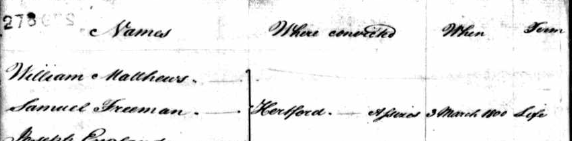
On 2 April 1787, Thomas Mansell was sentenced to seven years of transportation at Kingston, Surrey.
"The persons named in the underwritten list marked in the latter B being convicts for Felony and misdemeanour, were at the several ? of Gaol delivery and of the Peace holder for the ? cities and places and at the times against their respective names mentioned. Ordered and Adjudged for Transported beyond the seas to such place as his Majesty with the Advice of his Envoy Council should think fit to declare and appoint for the several ? mentioned again their respective names pursuant to the..."

 |
| I believe that says "Assizes for Co: at Kingston", |

Anna Maria Falconbridge was on a vessel bound for Africa, awaiting a fair wind when the third fleet vessels were readying to depart. She wrote several letters that were later published. In one of the letters written from Spithead and dated 12 January 1791, describes seeing the convicts:
"I have not been on shore at Portsmouth; indeed, it is not a desirable place to visit; I was once there, and few people have a wish to see it a second time. The only thing that has attracted my notice in the harbour is the fleet with the convicts for Botany Bay, which are windbound, as well as ourselves. The density of such numbers of my fellow creature has made what I expect to encounter set lighter upon my mind than it ever did before; nay, nothing could have operated a reconciliation so effectually; for as the human heart is more susceptible of distress conveyed by the eye than when represented by language, however ingeniously, pictured with misery, so the sight of those unfortunate beings, and the thoughts of what they are to endure, have worked more forcibly on my feelings than all the accounts I have ever read or heard of wretchedness before..."
George Barrington, a "celebrated" pickpocket, was one of the convicts in the fleet who travelled on the Active from Newgate. He recorded some of the details of the voyage in "A Voyage to Botany Bay", published in 1796, travelling to Santa Cruz, on Tenerife, in the Canary Islands, off the west coast of Africa, then Cape Frio, Namibia, around the Cape of Good Hope on the southern tip of South Africa, and finally into Port Jackson, Sydney, Australia.
The Matilda was the second ship to arrive in Sydney on 1 August 1791. She came with news that there were another nine ships making their way to Sydney, and which were expected to arrive shortly. The final vessel, the Admiral Barrington, did not arrive until 16 October, nearly eleven weeks after the Matilda.
"On board the Matilda on arrival were two hundred and five male convicts; one ensign, one serjeant, one corporal, one drummer, and nineteen privates, of the New South Wales corps; and some stores and provisions calculated as a supply for nine months after their arrival."
Barrington gives the following account of the convicts disembarking:
"At ten o'clock the next morning the convicts were all ordered on shore; their appearance was truly deplorable, the generality of them being emaciated by disease, and those who laboured under no bodily disorder, from the scantiness of their allowance, where in no better plight. The boats from all the ships in the harbour attended, in order to land than; there in all two hundred and fifty mean, six women, and a convict's wife and child who had obtained permission to accompany her husband. We lost during the voyage thirty-two men. Upon their landing they were entirely new cloathed from the King's store, and their old things burnt, in order to prevent any infectious disorder that might have been in the ship from being introduced into the colony."
 |
| View of the Governor's house at Sydney in Port Jackson, New South Wales, Jan'y 1791 [picture] / W. Bradley - National Library of Australia |
I don't have a lot of information about his life immediately after arriving in Port Jackson in 1791, until his marriage by common law to Ann Sandall in the early 1800s and having a daughter, Elizabeth Sandall (using her mother's surname) in 1805. He is listed in 1806 (aged 50 and having been in the colony for 15 years as a bricklayer in Sydney and then marrying Isabella Sidwell in 1807.
In 1810, he was pardoned -

 |
| Thomas Mansfield's land grant |
In the 1814 convict muster, he is listed as a "constable", and Isabella Sidwell is listed as his wife, and they have one child, although there is nothing listed in the birth records for this couple (although it could be Hannah - his child with Ann Bullen). In the 1822 muster, he is still living with Isabella.


Comments
Post a Comment